
“ Together with Rutte, [we] have developed a framework for a future settlement concerning Greenland and, by extension, the entire Arctic region. This solution, if pursued, will be very beneficial to the United States of America and all NATO members,” Trump exclaimed on Truth Social after meeting with Rutte in Davos. “ All the United States is asking for is a place called Greenland, ” he was heard saying in the Davos speech .
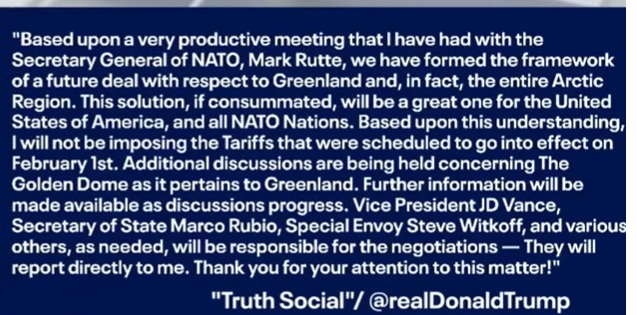
Mark Rutte has no mandate to negotiate about Greenland. That message came from Prime Minister Mette Frederiksen. The mandate is only the Danish government, with the approval of the Greenlanders. That sovereignty is a red line.
FAst Rutte did not negotiate about Greenland. Has first smeared Daddy Danold and given the chance to exit the president ended up in. Then Rutte seems to have lured with the fact that the US has free access to establish bases in Greenland. Which they already have. based on the agreement in 1951.
The foundation bolts
The 1951 agreement gives the United States very far-reaching rights to establish, operate and use military facilities in Greenland for the defense of both Greenland and the rest of the NATO area, but without Denmark renouncing sovereignty. The 2004 supplementary agreement primarily regulates the status of the Thule base (now Pituffik) in more detail and gives Greenlandic self-government a formal role, but in practice confirms the United States’ continued base rights.

The 2004 Supplementary Agreement regulates the status of Thule Base (now Pituffik). Greenland’s self-government has a formal role, but in practice confirms the continued basic rights of the United States. From the 1951 agreement:
- The US has “free reign” to operate militarily in Greenland in the sense that it can build and man bases across the island within the framework of the agreement, as well as control sea and air traffic around these facilities.
- American personnel have extensive freedom of movement in Greenland and are subject to special rules for access, taxes, fees, etc., which in practice gives the United States great operational freedom of action without paying base “rent”.
- In return, Denmark (and thus Greenland) receives an American security guarantee for the island within the NATO framework.
The agreements are described in detail at the end of this article.
US bases during the Cold War
In Pituffik in northwest Greenland, there are today 150 American military personnel, compared to about 10,000 during the Cold War. At that time, there were a number of bases around Greenland, shown in this map:
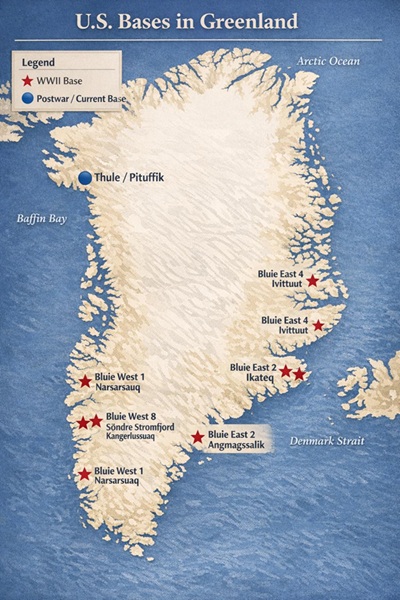
US generals called Greenland Blue and named the bases Blue West on the island’s southwest coast. Blue East protected the strait to Iceland.
- Blue West 8, Söndrefjord Air Port, is located sheltered along the fjord. Today as
Kangerlussuaq International Airport for tourists. The 140-kilometer-long fjord with a road to the sea is suitable as a naval base. In short, ideal for monitoring the air, the sea and space. - Blue West, 1, Narsarsuaq (UAK) in southern Greenland was built as an American base during the Cold War. Now vacated by the US as a new airport in Qaqortoq opens in 2026. Fjordland is suitable for a naval base. Potential for mining for one of the world’s largest deposits is being explored in the region.
/ By Ingemar Lindmark
1951 Defense Agreement
- The agreement is a bilateral defense cooperation within the framework of NATO, in which the United States commits to helping defend Greenland and the North Atlantic Treaty Area.
- The United States is given the right to establish, expand, maintain and use military bases and other infrastructure in places in Greenland that the parties agree are necessary for defense.
- American ships, aircraft and armed forces are granted in principle free access to Greenlandic territory, including overflights and landings, as well as ports connected to these bases.
- Denmark retains formal sovereignty and reserves the right to also use the defense areas together with the United States, as long as this does not hinder US operations.
- The agreement replaced previous war and post-war agreements and institutionalized the American presence during the Cold War (e.g. the construction of the Thule base).
2004 addition/update
- In 2004, a new, more detailed agreement was concluded on the legal and practical status of the Thule base; this took place after Greenland gained increased autonomy, and Greenlandic representatives were co-signatories.
- The agreement specifies, among other things, conditions for American presence, local economic issues (e.g. contracts for service activities) and confirms that Thule/Pituffik will remain a central American radar and air base without the United States paying formal rent.
- The 2004 update does not change the basic order from 1951 (Denmark’s sovereignty + very far-reaching American basic rights), but gives Greenland greater political and legal visibility in the arrangement.
Overall image
- Denmark/Greenland retains sovereignty, but the United States has a contractual right to have and use military facilities on the island for NATO defense, especially Thule/Pituffik.
- The United States can, after agreement with Denmark (and now with Greenlandic authorities), establish additional bases if this is deemed necessary for defense.
- The agreements ensure that the American military role in Greenland is both long-term and deep