
The question of whether one NATO country attacks another is legally complex, as NATO’s founding treaty (the North Atlantic Treaty) is primarily written to address threats from an external enemy. This also applies to threats of military force as defined in the UN Charter.
If one NATO country attacks another, the aggressor ceases to be considered an ally in that specific situation. The Alliance is then expected to support the attacked country, while the aggressor is isolated politically and militarily.
There is no specific article that explicitly dictates step-by-step what happens in the event of internal disputes, but in practice the following principles would apply:
1. Article 5 applies to the attacked party
Article 5 states that an armed attack against one member shall be considered an attack against all. It does not distinguish whether the attacker is a member or not.
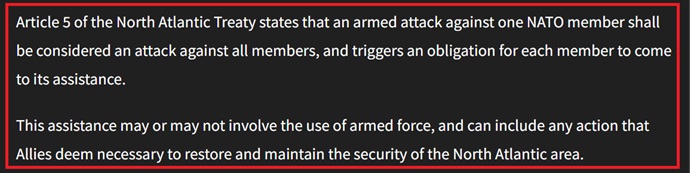
- Obligation to defend: If a NATO country (Country A) unprovokedly attacks another NATO country (Country B), the other member countries are in theory obliged to assist Country B.
- The aggressor loses its rights: According to a 1954 resolution, NATO has made it clear that a member state that uses force in violation of the UN Charter loses its rights to guarantees and military support from the alliance.
2. Political exclusion and isolation
NATO has no formal mechanism for ”kicking out” a country, but in the event of a mutual attack, the following would happen politically:
- Consensus minus one: Decisions in NATO are normally made by consensus (everyone must agree). Which is NATO’s inherent weakness, especially with the weight of the US in the organization. As when Prime Minister Orban’s Hungary and Turkish President Erdogan delayed Sweden’s and Finland’s NATO accession. Even Liechtenstein with barely 40 thousand inhabitants can theoretically block NATO decisions.
- In a conflict, a principle would likely be used where the aggressor is excluded from the decision-making process.
- Suspension: The Alliance can freeze the attacker’s access to intelligence, military cooperation and political influence in the North Atlantic Council (NAC).
”Throwing out” the US, NATO’s heaviest member, is practically impossible. But European countries can freeze NATO participation and instead form bilateral/multilateral defense cooperation. For example, a Nordic or Northern European defense cooperation. Or possibly an EU-”NATO”.
An example of a bilateral agreement is the Defense Cooperation Agreement between the United States and Sweden and a number of other NATO countries. Consent from each country is required to grant American military access to its territory. The DCA agreement for Denmark and Finland has not entered into force.
Sweden
3. Articles 1 and 4: Mediation and consultation
Before a war breaks out, there are tools to prevent it:
- Article 1: Members undertake to settle international disputes by peaceful means.
- Article 4: Allows members to request consultations if they believe their territorial integrity or security is threatened. This has historically been used to de-escalate tensions (for example, between Greece and Turkey).
In the case of Greenland, for example, Finnish President Alexander Stubb (who seems to have Trump’s ear) would take on the role of mediator. In the same way as Urho Kekkonen in connection with the Helsinki Conference in 1975.
4. Historical example: Greece and Turkey
These two countries have been on the brink of war several times (for example, the Cyprus crisis in 1974).
- NATO’s role: On these occasions, NATO (and primarily the US) has acted as a mediator behind the scenes. NATO has functioned as a ”shock absorber” forcing the parties to the negotiating table because a war within the alliance would weaken the entire Western bloc’s defenses.
Scenario: “The Arctic Rift” (2025–2026)
Phase 1: Russian expansion in the Norwegian Sea
After consolidating its forces in the Arctic, Russia is embarking on a massive naval exercise that never ends. Under the pretext of “protecting infrastructure,” they are permanently deploying sensors and robotic platforms at the strategic Bear Gap (between Svalbard and the North Cape).
- The provocation: Russian nuclear submarines begin openly shadowing civilian ships in the Norwegian Sea. NATO countries in Europe demand countermeasures, but Washington hesitates.
- US analysis: The White House assesses that Russia’s grip on the Arctic threatens US mainland defense (NORAD). They believe that European allies are too weak and slow in their response.
Phase 2: “Operation Ice Curtain” – US attacks Greenland
After months of failed attempts to buy Greenland or force Denmark to give up control of the island, the United States declares that Greenland is “crucial to national security in a multipolar world.”
- The attack: In the spring of 2026, the US launches a lightning-fast air landing at Thule Base (Pituffik) and Nuuk. They declare Greenland a temporary protectorate to “prevent Russian aggression.”
- Denmark’s response: Denmark immediately calls an emergency meeting of the North Atlantic Council and invokes Article 5 .
Phase 3: NATO collapse
Since decisions in NATO require consensus (everyone must agree), a legal and political impasse arises.
- Article 5 crisis: The US vetoes any attempt to activate Article 5 against itself. However, the European members (including Sweden, Norway and the UK) declare that the US has forfeited its status as an ally through its unprovoked attack.
- Cooperation ends: In what is known as “The Brussels Divorce,” the European members (plus Canada) agree to freeze U.S. membership indefinitely. American officers are escorted out of NATO headquarters in Mons.
- European Defense: France and Germany take the lead in forming a “European Security Union” to replace NATO’s command structure in Europe. The US is ordered to vacate its bases at Ramstein (Germany) and Mildenhall (UK).
Phase 4. In this scenario, NATO ceases to exist in its current form.
We see three new power blocs:
- The Arctic Zone: The US occupies Greenland and acts unilaterally in the north.
- The “New NATO”: A European-Canadian alliance without the US, which is forced into a massive rearmament to deter both Russia and a now erratic US.
- Russia’s move: Russia is exploiting the division between the Western powers by further strengthening its presence in the Norwegian Sea, which leads to the Nordic countries (Sweden, Norway, Finland) ending up on the front line between two rival superpowers.
Russia occupies Svalbard and puts thumbscrews on Iceland and the Faroe Islands. The Nordic countries adapt to a new world order squeezed between two superpower blocs.
/ By Ingemar Lindmark